

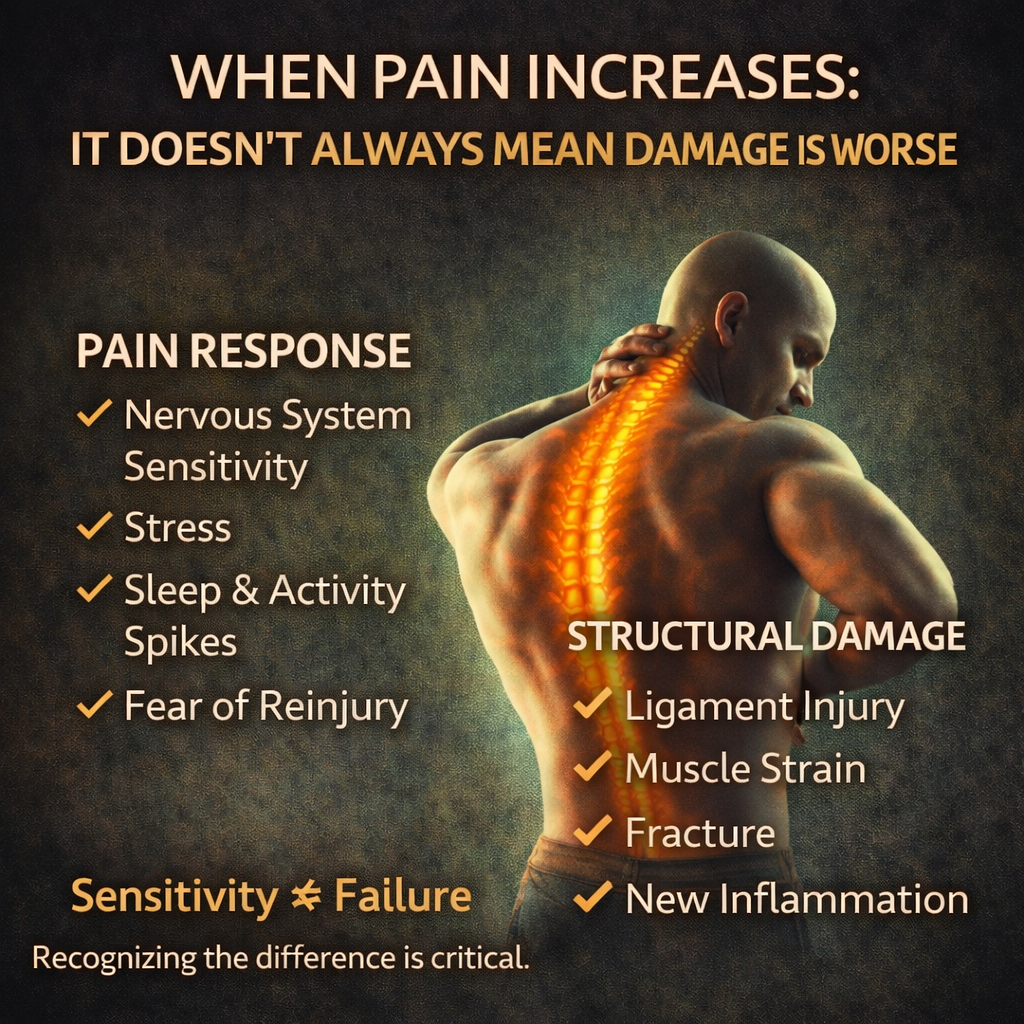
One of the most common assumptions in pain is this:
“If it hurts more, something must be worse.”
It sounds logical. But pain is not a direct damage meter.
Pain is a protection response.
And protection responses can increase even when tissue damage has not changed.
Understanding the difference between sensitivity and structural injury is one of the most important steps in breaking the flare-up cycle.
Pain Is a Protection Response
Your nervous system constantly evaluates perceived threat.
When perceived threat rises, pain can rise.
That increase can happen because of:
• Stress
• Poor sleep
• Sudden spikes in activity
• Emotional strain
• Fear of reinjury
None of those automatically equal new structural damage.
They increase system sensitivity.
When sensitivity increases, normal loads can feel amplified.
Pain intensity can go from 6/10 to 8/10 without new injury.
That doesn’t mean you’re deteriorating.
It often means the system is temporarily more reactive.
Structural Damage Is Different
Structural injury typically involves measurable tissue disruption such as:
• Muscle strain
• Ligament injury
• Fracture
• Significant inflammation from trauma
Those situations usually involve clear mechanical events.
But many flare-ups happen without new trauma.
The system becomes reactive — not broken.
Confusing sensitivity with structural failure often leads to overcorrection:
• Complete shutdown
• Aggressive stretching
• Avoidance of all activity
Both can prolong symptoms.
Capacity Tells a Different Story
Pain intensity alone does not define progress.
Capacity does.
Example:
If walking 3 steps spikes pain to 9/10 this week
But 2 weeks later you can walk 8–10 minutes before reaching 9/10
Your pain may still feel high —
But your capacity improved.
That is progress.
Capacity expansion is how we break pain cycles.
Regulation Beats Force
When sensitivity increases, the correct response is regulation — not force.
Reduce load.
Shorten duration.
Maintain gentle movement.
Lower perceived threat.
Movement remains medicine.
Motion is lotion.
The goal is not to eliminate all discomfort instantly.
The goal is to build tolerance gradually.
Structured Support
If you want a structured framework for managing flare-ups and building capacity gradually, start with the Free Guide below.
Download the Free Guide:
For those who want additional support during recovery phases, I also maintain a small curated PCS Dispensary with products I personally trust.
This includes:
• Clinician-grade supplements (magnesium, omega-3s, recovery support)
• Topical support options
• CBD products for short-term comfort when appropriate
These tools are optional and are not replacements for movement, load management, or structured rehabilitation — but they may support comfort and recovery when used appropriately.
You can view the PCS Dispensary here:
Thorne Supplements:
https://www.thorne.com/u/PR2106491
CBD Dispensary:
https://paincaresupply.com/product-category/cbd
Education first.
Structure first.
Tools support the process — they don’t replace it.