

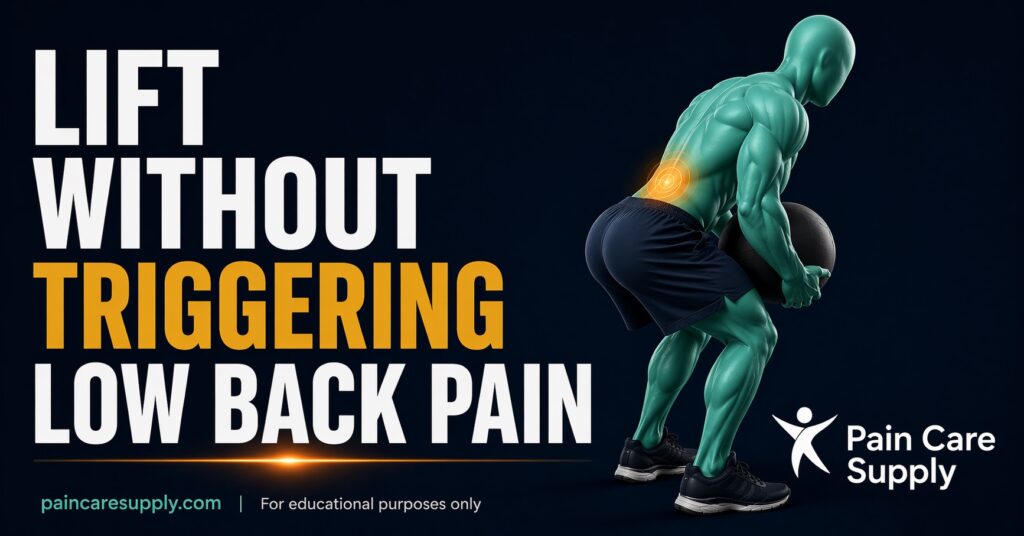
You did not hurt your back at the gym.
You hurt it picking up groceries. Or pulling laundry out of the dryer. Or grabbing something off the floor without thinking about it.
And if that keeps happening — every time, with almost everything you lift — you have probably started dreading the moment before you reach down.
That dread is real. And it makes sense.
But here is what most people never get told: the problem is usually not the object. It is not even the back.
It is the pattern.
——
THE PATTERN MOST PEOPLE USE — AND WHY IT COSTS THEM
When most people lift something, they reach forward first. Then they round through the spine to get low. Then they muscle the object up while holding it away from their body.
Repeat that dozens of times a day — groceries, laundry, boxes, bags, bending at the desk — and the load accumulates.
Your spine does not know the difference between a deadlift and a laundry basket. It only knows position, force, and repetition.
If the position is wrong every time, the repetition works against you.
That is the villain here. Not weakness. Not age. Not a broken back.
The pattern.
——
THE TURNING POINT — YOUR BODY ALREADY KNOWS HOW TO DO THIS
Here is what changes everything:
Your spine was not designed to be the first thing that moves when you pick something up.
Your hips were.
The hip hinge is not a new exercise. It is the movement pattern your body was built for. It means loading through the hips first — letting the large muscles of the glutes and legs absorb the demand — while the spine stays neutral and controlled.
When you lift this way, the load distributes differently. The back is no longer doing a job it was never meant to do alone.
——
HOW TO DO IT — 5 STEPS
Step 1 — Stand Close to the Object
Do not reach from far away. Step close enough that the object is directly in front of you. Distance between you and the object is one of the fastest ways to increase spinal load.
Step 2 — Push Your Hips Back
Initiate the movement by pushing your hips backward first — not by rounding your back down. The hips go back. The torso follows naturally.
Step 3 — Let Your Knees Soften
As your hips go back, your knees will bend naturally. Let them. You are hinging — not squatting. The difference is where the movement starts.
Step 4 — Keep Your Chest Proud and Torso Controlled
Maintain a neutral spine throughout. Your chest stays up. Your back does not round. You do not need to be perfectly rigid — just controlled.
Step 5 — Keep the Object Close and Stand Smoothly
Once your hands are on the object, keep it close to your body as you rise. Drive through your legs. Move smoothly and with control. Avoid jerking, twisting, or rushing the finish.
——
WHAT YOU SHOULD FEEL
Controlled effort in the hips and legs.
Mild tension — not sharp pain.
More balance and more control than before.
WHAT YOU SHOULD NOT FEEL
Sharp pain.
A sudden catch in the low back.
Symptoms shooting down the leg.
If symptoms increase during or after the movement — stop and reassess. Do not push through sharp or shooting pain.
——
START SMALL — BUILD THE PATTERN FIRST
Do not test this with your heaviest object first.
Start with something light enough that you can focus entirely on how the movement feels.
Empty laundry basket.
Light grocery bag.
Small box.
Backpack with minimal weight.
The goal at this stage is not load. It is pattern. Get the movement right before you add demand.
Once it feels controlled and your symptoms are not increasing, begin to add weight gradually. Increase repetitions before increasing load. Practice with real-life tasks.
Consistency with a better pattern will do more for your low back than one perfect lift followed by ten careless ones.
——
COMMON MISTAKES TO AVOID
Reaching too far forward before the hips go back.
Jerking the weight up instead of driving smoothly.
Twisting through the spine while the object is in your hands.
Holding the object away from your body while standing.
Holding your breath aggressively throughout the lift.
——
A QUESTION WORTH SITTING WITH
After a week of practicing this pattern — is lifting starting to feel more controlled? Or does your back still react the same way?
That answer will tell you a lot about what to do next.
——
RED FLAG PROTOCOL
Stop and seek immediate medical attention if you experience:
— Loss of bladder or bowel control
— Numbness or tingling in the groin or inner thigh
— Sudden severe weakness in both legs
— Chest pain, dizziness, or difficulty breathing during movement
— Symptoms that are rapidly worsening
Stop and consult a licensed provider before continuing if you experience:
— New or increasing numbness or tingling down the leg or into the foot
— Sharp shooting pain that worsens with every attempt at movement
— Significant increase in symptoms after two or more sessions
— Fever, unexplained weight loss, or night pain that wakes you from sleep
If you experience sharp pain, numbness, tingling, or any symptoms listed above — stop immediately and consult a healthcare provider.
——
YOUR NEXT STEP
If lifting keeps triggering your low back pain and you are tired of guessing your way through it — do not wait until it gets worse.
Start here: paincaresupply.com/free
——
Medical disclaimer: This content is for informational and educational purposes only. It is not medical advice and does not replace the guidance of a licensed healthcare provider. If you are