

MEDICAL DISCLAIMER:
This content is for informational and educational purposes only. It is not medical advice and does not replace the guidance of a licensed healthcare provider. If you are experiencing pain, injury, or any health condition, consult a qualified medical professional before beginning any movement or self-management program. Do not use this content to diagnose or treat any condition.
────────────────────────
Your back is not breaking down randomly.
It is breaking down during specific moments. Standing after sitting. Getting out of the car. Bending too fast after staying still too long. Changing positions in the middle of the night.
Same moments. Same pattern. Every time.
And if you are like most people dealing with recurring low back pain — nobody has ever explained to you why those specific moments keep triggering the same reaction.
You have been told it is your posture. Your core. Your disc. Your chair. You have stretched, adjusted, tried new things. It helps for a while. Then the same week comes back. The same morning stiffness. The same afternoon buildup. The same moment getting out of the car that stops you cold.
That cycle has a real explanation. And it is not what most people think.
────────────────────────
WHAT IS ACTUALLY HAPPENING
While you sit — your spine absorbs load continuously. Your discs are under compression. Your hip flexors shorten and tighten. Your glutes partially shut down. Your trunk stiffens around the lumbar spine to protect it.
None of that is a problem in the short term. The problem is what happens next.
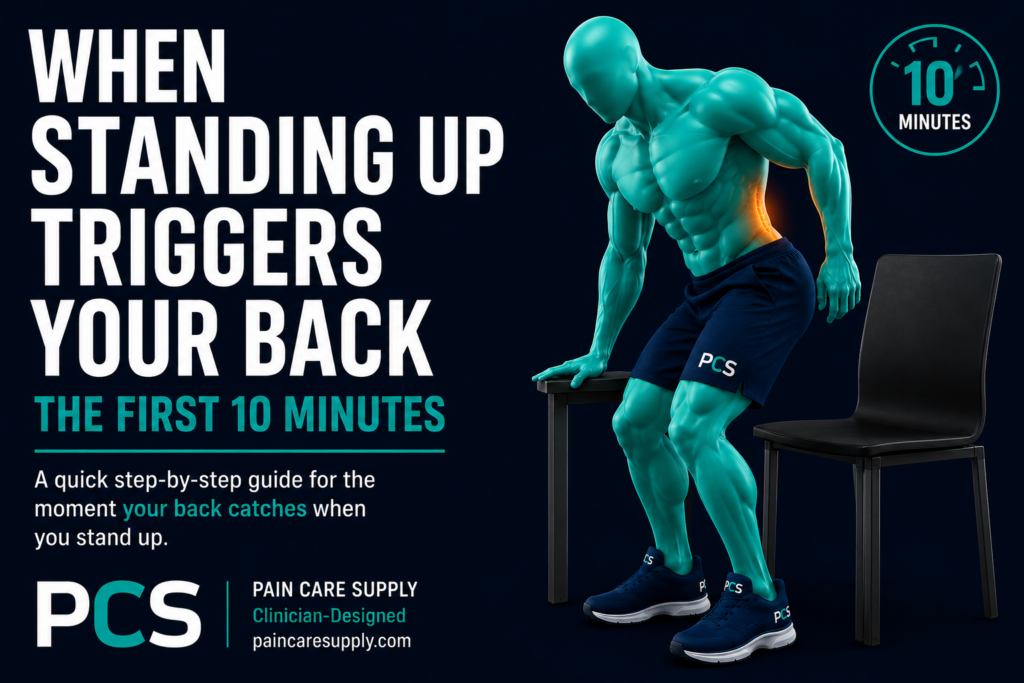
When you stand — especially after sitting for a long period — the spine has to transition from a sustained static load position to an upright dynamic position. That transition requires the hips, glutes, and legs to absorb force and contribute to the movement.
But after prolonged sitting — the hips are tight, the glutes are inhibited, and the trunk is stiff. So the lower back absorbs the transition force instead. All of it. At once.
That is the moment most people feel the catch. The pinch. The lock-up.
The movement did not break your back. The load pattern that built before it did.
────────────────────────
WHY STRETCHING HARDER DOES NOT FIX IT
During a flare your nervous system is already in a heightened threat state. The surrounding tissue is sensitized. Aggressive stretching forces the spine toward its movement limit while the threat response is already elevated.
Pain almost always increases.
The first goal during a flare is not more movement. It is less unnecessary load. Slower transitions. More deliberate use of the legs. Shorter sitting periods. Staying well within a tolerable range.
That is the pattern change that actually breaks the cycle.
────────────────────────
THE FIRST THING TO CHANGE
Every time you stand from any seated surface — desk chair, car seat, couch, bench — slow the transition down completely.
Shift to the edge of the seat. Both feet flat on the floor. Lean forward from the hips — not by rounding the spine. Load the legs first. Then rise gradually.
Pause two to three seconds at the top before taking a step.
You should feel controlled effort through the legs — not a sharp catch in the lower back.
This single habit change has more daily impact than any stretch or exercise you could add to your routine.
────────────────────────
IF YOU WANT THE COMPLETE SYSTEM
This week Pain Care Supply released a 61-page plain-language guide built for anyone whose back keeps breaking down.
Why Your Back Keeps Breaking Down covers everything that was not explained to you — plain-language anatomy, real-life scenario protocols, a four-step topical system, a flare response system, a progressive four-level exercise system, pain science, sleep protocols, a daily checklist and tracker, and a complete resource summary.
It was written for desk workers, tradespeople, parents, drivers, athletes, and anyone stuck in the same recurring cycle.
Clinician-designed. Built for your actual life — not a clinic, not a gym, not a floor routine that requires thirty minutes you do not have.
Available now on:
Amazon → https://a.co/d/0bsURLiH
Gumroad → https://coreyassist.gumroad.com/l/fjxix
Etsy → https://paincaresupply.etsy.com/listing/4503472238
paincaresupply.com → https://paincaresupply.com/pcs-digital-library/
────────────────────────
NOT READY TO PURCHASE YET?
Start with the free guide at paincaresupply.com/free
It is the first step into the PCS system — no purchase required.
────────────────────────
This content is provided by Pain Care Supply. Some links may lead to products or services we offer. We may benefit commercially from your use of those links.
© Pain Care Supply. All rights reserved.