

Understanding Load, Capacity, and the Cycle That Triggers Repeated Flare-Ups
MEDICAL DISCLAIMER
This content is for informational and educational purposes only. It is not medical advice and does not replace the guidance of a licensed healthcare provider. If you are experiencing pain, injury, or any health condition, consult a qualified medical professional before beginning any movement or self-management program. Do not use this content to diagnose or treat any condition.
────────────────────────
FTC DISCLOSURE
This content is provided by Pain Care Supply. Some links may lead to products or services we offer. We may benefit commercially from your use of those links.
────────────────────────
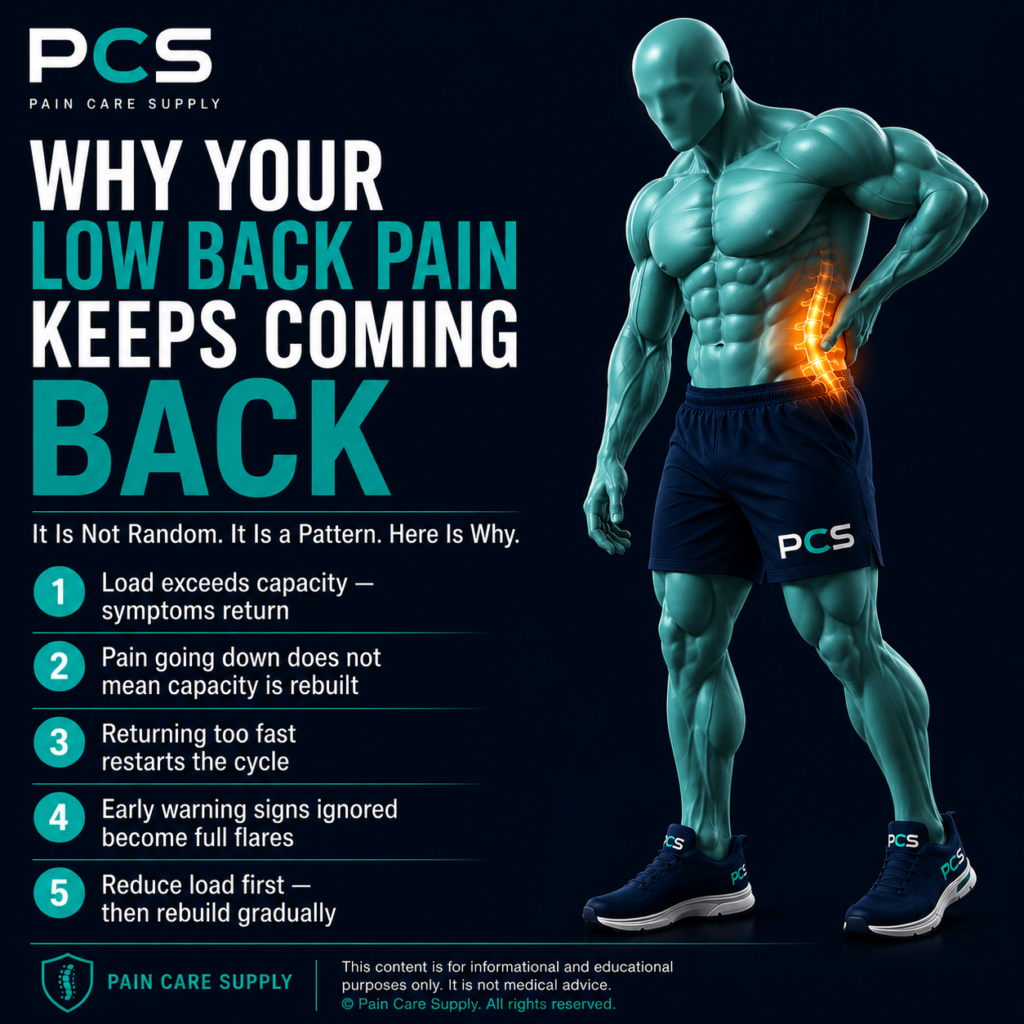
WHY YOUR LOW BACK PAIN KEEPS COMING BACK
You were doing fine. Then you sat too long. Lifted something awkward. Slept wrong. Drove too far. Reached for something completely ordinary.
And now you are back at the beginning.
That cycle is not bad luck. It is not a fragile back. And it is not random.
It is a pattern. And until you understand what is actually driving it — nothing you try is going to change it.
────────────────────────
THE PATTERN MOST PEOPLE NEVER GET EXPLAINED
Most people spend years trying to fix the wrong thing.
The perfect chair. The perfect stretch. The perfect exercise. And the pain keeps coming back anyway.
Because none of those things addressed what was actually driving the cycle.
Your low back has a current capacity. A threshold for how much daily demand it can absorb before symptoms start rising.
When demand stays within that threshold — things feel controlled.
When demand repeatedly exceeds it — symptoms return.
Most people never get that explained to them. So they keep chasing solutions to the wrong problem.
────────────────────────
WHY PAIN RETURNS AFTER IT FEELS BETTER
Here is the moment most people get wrong.
The flare calms down. The pain backs off. And immediately — almost automatically — everything goes back to normal.
Same sitting habits. Same movement patterns. Same routine.
Within days the cycle starts again.
Pain going down does not mean capacity has fully rebuilt. That is the trap. You feel better before you are actually prepared. Then the same daily demands push the system past tolerance again.
Most people repeat this cycle for months. Some for years.
────────────────────────
THE LOW BACK RECURRENCE LOOP
The cycle looks like this — and most people recognize every step.
Symptoms flare.
Rest or reduce activity.
Pain decreases.
Return to normal too quickly.
Load exceeds capacity again.
Symptoms come back.
The missing piece is not more fear. It is not more rest.
It is something most people never address — and that is why the pattern keeps repeating.
────────────────────────
COMMON LOADS THAT BUILD UP DURING THE DAY
Most people search for one big event that caused the flare.
But often it is not one thing.
It is the total accumulated load — the sitting, the driving, the stress, the poor sleep, the repeated bending — compounding across the entire day until the system has absorbed more than it can handle.
Sitting too long without changing position.
Driving for extended periods.
Repeated bending.
Poor sleep reducing recovery overnight.
Stress carried in the muscles.
Doing too much too soon after a flare.
Ignoring early warning signs.
Small stressors stacking silently. That is what most flares are built from.
────────────────────────
THE BIGGEST MISTAKE
Waiting until symptoms are severe before changing anything.
Most people push through the stiffness. Push through the tightness. Push through the early signals.
Until the system has no choice but to stop them.
By then recovery takes significantly longer than it would have if the signal had been respected earlier.
────────────────────────
WHAT ACTUALLY NEEDS TO CHANGE
Most people focus on what to do during a flare.
Very few focus on what to change between flares — which is where the real work happens.
That pattern — and the specific sequence for changing it — is what the complete system covers.
If you are ready to stop guessing and start working with a structured approach:
Get the free guide at paincaresupply.com/free
Get the complete book — Why Your Back Keeps Breaking Down:
coreyassist.gumroad.com/l/fjxix
────────────────────────
OPTIONAL SUPPORT TOOLS
If load keeps building faster than your body can recover — these are tools people commonly keep nearby to help manage discomfort and stay consistent.
They will not fix the problem. But they may help reduce pain and discomfort so you can move better and build tolerance again.
Biofreeze Pain Relief Gel
3,500mg CBD Pain Relief Cream — Biotech CBD
Bob and Brad D6 Pro Percussion Massager
This content is provided by Pain Care Supply. Some links may lead to products or services we offer. We may benefit commercially from your use of those links.
────────────────────────
RED FLAG PROTOCOL
STOP and seek immediate medical attention if you experience:
Loss of bladder or bowel control.
Numbness or tingling in the groin or inner thigh.
Sudden severe weakness in both legs.
Chest pain, dizziness, or difficulty breathing during movement.
Symptoms that are rapidly worsening.
STOP and consult a licensed provider before continuing if you experience:
New or increasing numbness or tingling down the leg or into the foot.
Sharp shooting pain that worsens with every attempt at movement.
Significant increase in symptoms after two or more sessions.
Fever, unexplained weight loss, or night pain that wakes you from sleep.
If you experience sharp pain, numbness, tingling, or any symptoms listed in the red flag section — stop immediately and consult a healthcare provider.
────────────────────────
FINAL PRINCIPLE
Low back pain that keeps coming back is not random. It is a pattern.
And patterns can be changed — but only once you understand what is actually driving them.
If you are tired of guessing and ready for a system that addresses the real problem — start here:
paincaresupply.com/free
© Pain Care Supply. All rights reserved.